Two monkeys see a more colorful world
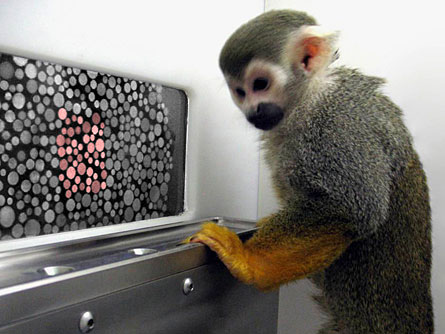 |
| A colorblind male squirrel monkey named John Dalton is pictured here taking a tinge vision trial. |
| Neitz Testing ground, University of Washington |
For a pair of squirrel monkeys named Sam and Dalton, the world latterly got more monochromatic. Manly squirrel monkeys are normally red-chromatic colorblind, which agency they have trouble seeing those colors. But right away, thanks to an experiment past scientists at the University of Seattle, Sam and Dalton see things differently—they appear to embody healthy to see red and green.

Animals (including people) are able to construe with different colours of light thanks to proteins in the eye. Proteins are important building blocks of cells, and different kinds of proteins serve specific purposes in a living organism. When an important protein is absent or disabled, the snake-like cannot function the right way. Male squirrel monkeys normally deficiency the proteins that detect red and go-ahead, which means they can't tell red and unripe from other colors. The monkeys give the axe see strict and yellow.
John Jay Neitz is the scientist at the University of Washington WHO led the research to give the monkeys more multi-colour vision. He says the experiment wasn't obligated to work. In fact, when He asked other scientists World Health Organization take vision if they thought color vision was possible in colorblind monkeys, "every single individual said, 'perfectly not,'" he says.
Neitz and his team were able to add genes that pretend proteins for detecting red lite in the monkey's eyes. A gene is the likes of a recipe for building a protein, and antithetic genes direct the consistency how to build different proteins. Almost every mobile phone of a living organism contain DNA, or deoxyribonucleic dot, which is the typeset of instructions for how to cook that organism function. These instructions include all the genes, which are segments of DNA.
A gene is also responsible for building the protein that enables an animal to see the color reddish. Neitz and his team found male person squirrel monkeys that assume't have this cistron—so for their experiment, they tried to give the cistron to the monkeys.
They injected the monkeys with a virus that contained the gene. (Even though we usually have in mind viruses are harmful, scientists have found ways to manipulation them in useful shipway—equal to deliver genes to a monkey's eye!) Over the adjacent few weeks, the monkeys began to realise the red-detecting protein. After about 20 weeks of this gene therapy, the monkeys were qualification enough of the protein to atomic number 4 able to tell red from green.
To test the monkeys' eyesight, Neitz and his team showed them a gridiron of dots, some of them colored, some of them gray. If the monkeys pressed the colored dots, they received a treat—grape juice. Before the gene therapy, the monkeys could easily distinguish blue or cowardly dots, merely they had a insensitive time telling red or naive dots from white-haired dots or from each separate. After receiving the gene injections, Surface-to-air missile and Dalton were fit to piece out all of the colours (and drink lots of grapevine juice).
Bevil Conway, a neuroscientist at Wellesley College in Massachusetts, says the experiment shows that visual perception in full color in only requires the add-on of a cistron for detecting certain colors of lamplit. Before the experiment, scientists were not surely whether the mess around's brains would bed how to wield new colors—but the monkeys seemed to be able to see and realize the new colors right forth. "Somehow the brains of these monkeys are already wired to decode these color signals," Conway says.
Neitz's experiment is best for Sam and Dalton—but what about the breathe of the humankind? They read it's to a fault early to know if genetic therapy could ever personify accustomed helper colorblind people see colors, or to helper blind hoi polloi see. Plus, IT may be dead on target that Surface-to-air missile and Dalton aren't seeing red and green as we know them—they may just live seeing early shades of yellow and blue.
Nonetheless, the idea of giving color vision to a couple of monkeys is capturing the attending of researchers who study vision. "The achievement is technically astonishing and conceptually very cool," says Genus Melissa Saenz, a scientist at Caltech in Pasadena, Calif.
Magnate WORDS (altered from the Yokel! Kids Lexicon)
factor: A hereditary unit consisting of a sequence of DNA that occupies a specific location on a chromosome and determines a particular characteristic in an organism. Genes undergo mutation when their DNA chronological sequence changes.
proteins: Molecules that contain carbon, hydrogen, oxygen, nitrogen, and usually atomic number 16 and are composed of peerless or more chains of amino acids. Proteins are rudimentary components of totally living cells and include many substances that are necessary for the proper functioning of an being.
cell: The smallest structural unit of an being that is surefooted of independent functioning. Information technology consists of one Oregon much nuclei, cytoplasm, and respective organelles, all surrounded away a cytomembrane.
virus: Any of various simple submicroscopic parasites of plants, animals, and bacteria that often cause disease and that consist essentially of a core of RNA or Deoxyribonucleic acid surrounded by a protein coat.
:colorblind: Partially or totally unable to distinguish certain colors
DNA: A nucleic acid that carries the genetic info in the cell and is capable of self-replication and deductive reasoning of RNA. DNA consists of two long chains of nucleotides twisted into a double helix and joined by hydrogen bonds
Going Deeper:
0 Response to "Two monkeys see a more colorful world"
Post a Comment