what is the best way to find out what children understand about a thematic topic
Following my posts, Post-obit Children'southward Interests and What Happens When You Follow a Kid's Involvement?, I wanted to clarify the ways in which following a child's (or group of children'due south) interest differs from learning about a given 'theme.'
I consider there are two major differences
- Who takes the pb, and
- How the content is formulated.
Who Takes the Lead?
Traditionally, with a thematic education approach, the educator (and I use the word 'educator' to point the adult the child is learning alongside, this may be a teacher in a formal surround or a parent in a domicile environment) decides upon the theme to exist studied.
With an Emergent Curriculum approach, the educator shares the driving seat with the kid and the child'southward words, actions, thoughts and play guide the learning curriculum. Then, given the child's current fascination with and questions about a topic, the focus of the learning and selection of activities evolves. Of grade, the educator volition residual this with knowledge of what skills s/he would like the child to be acquiring or practising, you can learn to count whether y'all are counting garbage trucks or daffodils.
How the Content is Formulated
Within a thematic curriculum planning approach, the educator chooses a range of resources, books and activities they experience would be interesting for the kid/ren to engage with. This approach is typically pre-planned and follows the sequence of activities adamant by the educator.
Inside an emergent curriculum, the educator considers;
- What the child/ren already knows near the interest,
- How to deepen the child'south level of understanding, finding answers to their questions,
- Advisable creative and communicative mediums that will let the child/ren to communicate their developing agreement,
- What questions to ask of the kid and research with the child to extend the involvement, and
- How to utilise the kid/ren's fascination to reinforce skill development (reading, writing, mathematical concepts, etc).
And they keep to revisit these questions as the investigation of the interest continues.

Could this be how Monet's gardens began?
An instance from the classroom;
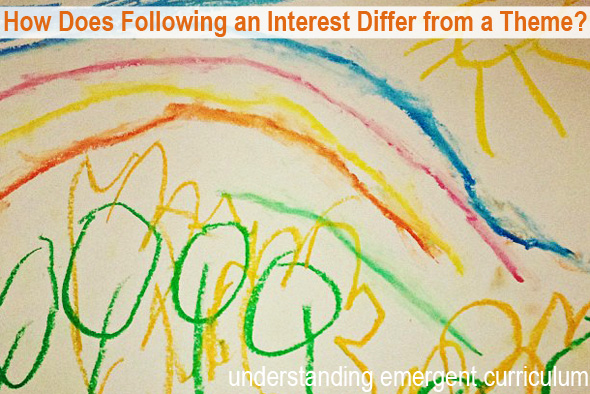
A grouping of iii-four twelvemonth olds had been cartoon and talking about rainbows repeatedly, sharing their experiences of where they had seen rainbows and what they looked like. Their educator asked, "When exercise you see rainbows?"
Child 1 responded, "Up in the sky."
Child 2 responded, "After it rains."
Child three then added, "Yeah, when its all wet."
Child two then added, "Yeah only then the sunday comes out and dries up all the rain and it goes up into the sky until it rains once again" (demonstrating with his easily).
Child 3 then added, "And the rainbow gets stuck in the copse," (laughing).
Kid four and then entered the conversation with, "It gets stuck above the trees."The educator then asks, "But how does the rainbow get there?"
Child 5, "Someone puts it there."
Child ane, "The rainbow guy makes them."
The conversation continued with the children agreeing that they weren't sure how rainbows were made; just that it had to be wet for them to get there.
This conversation provides the educator with lots of information about what the children know, or retrieve they know, about rainbows and it provides a great starting point for the learning program.
- The educator may utilise the record of this conversation to plan further questions to go the children to limited their ideas and understandings in more item (thinking and reasoning and communicating skills).
- The educator can choose to encourage the children to correspond what they 'know' creatively, perhaps designing and then making "rainbow making machines" with sculpture materials like paper mache or box construction (thinking and reasoning, problem solving, 3D mathematical and artistic skills).
- The educator could make a listing of research questions with the children about what they would like to know almost rainbows then utilize the internet or a library visit to find the answers (thinking and reasoning and literacy skills).
This short instance provides a snapshot of how an emergent curriculum approach is much more than organic and based upon the child'south responses to the learning plan, including learning from their misconceptions. The children will be developing lifelong learning skills in a style that is fun, engaging and interesting to them.
Do y'all teach using interests or themes?
Read more than of the Understanding Emergent Curriculum series;
Perspectives  | An Epitome of the Child  |
Are three Year Olds Likewise Immature to Vote?  | Is Your Instructor a Pirate?  |
The Kid in the Community  | Creating Learning Communities  |
Parents Participating  | Following Children's Interests  |
What Happens When You Follow a Child's Involvement?  | How Does an Interest Differ from a Theme?  |
Are Nosotros Supporting the Hundred Languages of Children?  | Revisiting the Hundred Languages of Children  |

delacruzsoneanto79.blogspot.com
Source: https://childhood101.com/emergent-curriculum-how-does-following-an-interest-differ-from-a-theme/
0 Response to "what is the best way to find out what children understand about a thematic topic"
Post a Comment